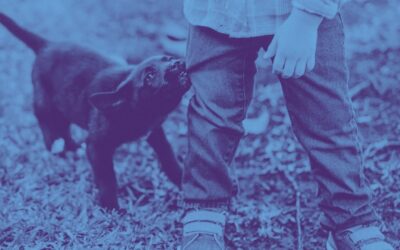
Your dog knows the rules. You’ve told them enough times. And yet the moment the front door opens, the moment they see a person they like (which is every person), all of it goes out the window. Front paws leave the ground. Someone gets body checked. You apologize, again. Your dog looks thrilled with themselves.
You’ve tried the spray bottle and turning away. And the knee-to-the-chest move you saw on YouTube. You tried treats at the door as a distraction. Some of these worked for a day or two. None of them worked for long.
Here’s what nobody told you: the problem isn’t that you’re using the wrong technique. The problem is that your dog is enrolled in two training programs simultaneously.
The one you’re running, and the one that every other person in their life is running without realizing it. And the second one is winning.
We’ve been working with Charlotte families on this for nearly two decades. For the short version and what a consultation looks like, see our Jumping on People page. Here’s everything you need to understand about why your dog jumps, and what it takes to stop it.
What Jumping Is Really About
Before you can fix the behavior, you need to understand what’s driving it. Most of the conventional wisdom about jumping gets this wrong.
Jumping isn’t about dominance.
Dogs don’t jump on people to assert rank, establish control, or challenge authority. That explanation was popular for a long time because of TV personalities. But it leads owners toward responses that either don’t work or actively make things worse. Dominance-based corrections applied to an attention-seeking, socially excited dog tend to either confuse the dog or escalate the greeting’s energy, neither of which is the goal.
Jumping is a greeting. It’s social. It’s enthusiastic. And it makes complete sense from the dog’s perspective.
Think about how dogs greet each other: nose-to-nose, face-to-face, reading scent information from the muzzle and eyes and ears. When a dog jumps on a person, they’re trying to do the same thing. Get to face level, make contact, connect. The problem isn’t the impulse because the impulse is friendly. The problem is that a 60-pound dog expressing a friendly impulse toward an unprepared human is a genuine hazard, and “friendly” doesn’t make it acceptable.
Understanding this nuance matters because it changes how you think about the fix. You’re not dealing with a dog trying to dominate anyone. You’re dealing with a dog with a completely normal social drive that’s never been taught an appropriate outlet for it.
How the Habit Gets Built Over Time
Most jumping problems start before the owner realizes there’s a problem to prevent.
The puppy jumps up. It’s small and soft and the paws are the size of a quarter. Everyone bends down to greet it. Someone picks it up and laughs. The puppy gets face-to-face contact. Exactly what it was going for and the lesson is filed away: jumping works.
Then, the puppy gets bigger. The jumping is less charming. The owner starts saying “off,” “down,” and “no.” But the guests still bend down. The kids still let it happen because it’s fun. Grandma still thinks it’s sweet. And intermittently, unpredictably, the jump still produces exactly the same reward it always produced.
Behavior that’s reinforced on an unpredictable schedule becomes highly resistant to fading out, not because the dog is stubborn, but because the pattern of sometimes-yes and sometimes-no is more motivating than a consistent no ever could be. The dog keeps trying because trying has worked before, and they can’t know which attempt will pay off.
By the time most owners decide this is a real problem, the behavior has months or years of reinforcement history behind it. That doesn’t make it unfixable. It makes it harder to fix through inconsistent effort, which is exactly what most people try.
The Training Program You Didn't Know You Were Running
Here’s the part that frustrates most dog owners when they finally hear it clearly stated: every person who has ever petted your jumping dog has been a trainer. They just weren’t aware of it, and they weren’t teaching what you wanted taught.
The guest who said “oh, I don’t mind dogs” and let your dog jump all over them “Trainer.” That family member who “doesn’t want to be the bad guy” during the holidays “Trainer.” The kid who thought it was funny and encouraged it “Trainer.” Your neighbor who reached down to pet the dog mid-jump because it seemed mean not to “Trainer.”
Every one of those interactions added a data point to your dog’s understanding of what jumping produces. And the sum of those data points, accumulated over months of socializing and guests and greetings, is a deeply reinforced behavior pattern that your occasional corrections can’t compete with.
This is why technique is almost never the issue when owners struggle with jumping. They know to turn away. They know not to make eye contact. They know the principles. What they can’t control is every other person their dog encounters, and until that’s solved, the behavior persists.
Five Common Fixes That Don't Hold
Turning away and ignoring.
Correct in principle, insufficient in practice. It works when you do it consistently, every time. It doesn’t work when other people don’t do the same. If ten interactions happen in a week and you successfully ignore the jump in six while four result in attention, you’ve got intermittent reinforcement. The behavior stays.
Pushing the dog down.
Physical contact is still contact. For a social, attention-seeking dog in an excited greeting state, hands on their body, even hands pushing them away, register as engagement. Some dogs actively learn that jumping produces an interesting physical response from their owner. You haven’t punished the behavior. You’ve added a layer of stimulation to it.
The knee to the chest.
This can startle a dog in the moment and interrupt a specific jump. It does nothing to teach the dog what to do instead, and applied with any force, it carries injury risk. It also requires precise timing that most owners and guests don’t have. Miss the timing, and you’ve just reacted, which is still a reaction.
Teats at the door as a distraction.
Redirecting, aka “bribing” with food, can be an effective management tool in specific, controlled scenarios. It doesn’t address the behavior itself. The dog learns to expect a treat when guests arrive, not to keep four paws on the floor. Remove the treat and the jumping returns.
Isolating the dog when guests arrive.
Often presented as the safe option. It isn’t neutral. A dog repeatedly isolated during social events doesn’t learn better greeting behavior; they learn that arrivals lead to confinement, which can produce frustration and anxiety that makes the underlying excitement worse over time. It manages the symptom without touching the cause.
What the Dog Needs Instead
The key insight that changes how you approach this: you can’t just train what the dog should stop doing. You have to train what the dog should do instead.
A dog that jumps on people when excited has a legitimate need. Greeting, connection, social contact. If all you do is suppress the jumping without giving them an alternative, you have a dog that’s frustrated and confused, not a dog that understands how to greet properly.
What works is building a reliable alternative behavior that’s incompatible with jumping. A dog that sits cannot be airborne at the same time. A dog that holds a down-stay at the door cannot be launching themselves at guests. The goal isn’t to eliminate the excitement; it’s to channel it into acceptable behavior that gets the dog what they actually want: interaction, attention, and connection with the people they like.
This is what trainers sometimes call the “dead dog rule”: any training goal worth pursuing should be stated in terms of what the dog does, not what they don’t do. Dead dogs don’t jump. A live, well-trained dog sits at greetings, waits for permission to approach, or holds a position at the door. That’s a meaningful goal, and it’s teachable.
The Consistency Imperative
None of this works without consistency, and consistency means every person, every time.
A training plan that one household member follows while others opt out isn’t a training plan. It’s a source of confusion for the dog and a direct pipeline for the intermittent reinforcement that keeps the behavior alive. The dog learns that the rule applies to some people some of the time, which means jumping is still worth attempting with everyone to find out which category they fall into.
Getting everyone on the same page is the hardest part of fixing jumping: not the training itself, not the technique, not the dog’s willingness to learn. It’s the human coordination problem.
One Charlotte family we worked with described their front hallway as “out of control” every time the doorbell rang. There were four different people in the house, four different reactions to the exact same jump, and a dog with every reason to keep testing which version he’d get that day.
In-home training that works with the whole household in Charlotte, Matthews, and Huntersville produces better results than anything an owner tries to implement alone.
When to Call a Professional
If any of these apply, stop trying to manage this on your own and get a trainer involved:
- The jumping has been happening for more than a few months with no lasting improvement.
- A child, elderly person, or guest has been knocked down or scratched.
- The dog jumps on people even when the owner is actively trying to prevent it.
- The behavior is getting more intense rather than less.
- Multiple people in the household are sending conflicting signals, and you can’t get everyone to be consistent.
Jumping is among the most common things we see in Charlotte families, and one of the most fixable when the right approach is applied consistently across the whole household. We come to your home, observe the dynamic at your door, work with the people who actually live there, and build a plan that accounts for your real situation. Our Jumping on People page has more on what that consultation looks like.
The longer this goes on, the more reinforcement history accumulates behind the behavior. Earlier is always easier.