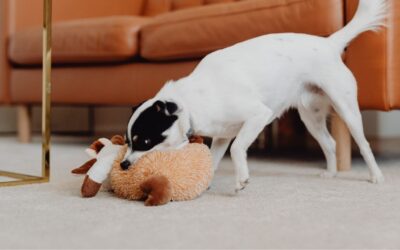
Since 2008 we’ve worked with more than 5,000 dogs, and almost nobody calls us because their dog acts up at a training center. They call about the doorbell. They call about the counter, or the dog who drags them past the neighbor’s fence every morning. Those problems happen at home, and after all these years I’m convinced home is where they get fixed. It’s the reason we do in-home dog training in Charlotte, and the way dogs actually learn backs it up.
Why do dogs learn best at home?
Dogs learn best at home because they tie a behavior to the place and moment where it happens, and most problem behavior belongs to very specific moments in the house. Train in the spot where the problem lives and your dog learns the new habit right where he’ll need it.
Everything your dog does is shaped by two things: what happens right before it, and what happens right after. The doorbell rings and he charges the door. Somebody yells “HEY!”, which to a dog sounds a lot like joining in. Behavior science puts it plainly: most behavior problems are highly tied to context. Your dog’s jumping might only show up when one particular person walks through one particular door.
Your dog isn’t stubborn, he’s confused. “Sit” in a quiet kitchen with a treat in your hand and “sit” at the front door while your in-laws ring the bell are two completely different questions to him. He only knows the answer to the first one.
A skill learned in one place doesn’t automatically travel
The professional training literature spells this out. You teach a dog to go lie down on his bed, and once he’s got it, you take it to other places and harder moments, like when a guest is over or while the family is eating dinner. Most of the real work lives in that second step.
One finding from the research is worth knowing. Family dogs with aggression problems at home got better while they were kept in a lab setting, and very little of that improvement came home with them. The reasons were complicated, but the lesson for owners is simple: a dog who’s easy somewhere else isn’t finished. If you’re weighing options, we’ve written about board and train versus lessons at home.
Customizing training for your dog
Every dog has its own learning rhythm. Some get it on the second try, and some need a week and a lot of patience from everybody.
Dogs also meet new things in very different ways. One walks right up to a stranger. Another goes back and forth and can’t decide, and another just wants to leave. Breed tells you a little. The dog in front of you tells you a lot more, especially a rescue with a history nobody wrote down.
Our second pillar says it best: “Always listen to what the dog is telling you.” A plan built for a confident young Lab will flatten a nervous rescue, and the reverse will bore the Lab silly. One owner with three rescues wrote that her trainer “quickly honed in on each dog’s personality and quirks and has adjusted lessons accordingly.” If your dog worries more than he misbehaves, see our fearful dog training page.
Customizing training for your family
In most houses the dog sits right in the middle of everything. Everybody loves him, and everybody has a slightly different deal with him. One person allows the couch and another doesn’t. The kids slip him crusts under the table and swear they didn’t.
Every family works like this, and your dog is learning from all of it, all day long. When barking at the window gets somebody to come over and talk to him, he’s been paid. Nobody meant to pay him. He got paid anyway.
Behavior experts recommend getting the whole family involved whenever possible, especially when the fix means changing routines. If the person who does the 6 a.m. walk never meets the trainer, the 6 a.m. walk doesn’t change.
Our third pillar is “Humans are in charge of thinking.” One client put it straight in a review: “training our puppy is really training us.” Your rules get to be your rules, too. A dog on the bed is fine if you want him there, as long as everybody in the house is asking for the same thing.
Customizing training for where you live
A townhouse in South End and a fenced acre in Huntersville are different worlds to a dog. Your doorbell has its own sound, and the dog behind your neighbor’s fence has his own opinions.
We train with all of it, because it’s what your dog has to live with. One client wrote that her dogs “now know how to stay in place when the doorbell rings.” Another, working through her rescue’s fear, had lessons “in my home, to meeting me downtown Matthews or at Lowe’s.” Start where your dog feels safest, then go where life actually takes the two of you.
If the hard part happens on the leash, our leash reactive dog training page goes deeper. For front-door trouble, look at barking or jumping on people.
What in-home dog training in Charlotte looks like with us
It starts at the first visit, in your home. We sit down and listen. What’s going on with your dog, and what do you want life with him to look like?
Then our trainers show you, right there in your living room or on your sidewalk. Once your dog starts getting it, you take the leash and we give you feedback on the spot. Afterward we follow up to see how it’s going when we’re not there, which is the only time that really counts.
Our first pillar is “Always work with the dog, never against it,” and we’re not training the goofy out of him. One family summed it up better than I could: “The training is completely tailored to our specific dog and our in home lifestyle.” There’s more on our in-home dog training page.
We do in-home dog training in Charlotte, Matthews, Huntersville, Fort Mill and Mint Hill.
One small thing to try tonight: notice where your dog’s worst five minutes of the day happen. Maybe it’s the front window, maybe the end of the driveway. Whatever spot it is, we’d want to see it first.
When you’re ready, book a free in-home consultation or call us at (844) 864-3647. We’ll come to you and meet your dog where he actually lives.