Living with an aggressive dog is exhausting in a way that’s hard to explain to people who haven’t done it. You scan every sidewalk before opening the front door. You make excuses when friends want to visit. You’ve probably already Googled “why does my dog do this” at 11 pm more than once.
Here’s what most owners don’t hear until they’ve already burned through a trainer or two: aggression isn’t your dog deciding to be dangerous. It’s your dog telling you something. Loudly — because nothing else worked.
Aggression Is Communication, Not Character
A dog that growls, lunges, snaps, or bites is a dog under pressure. The behavior is the symptom. Fear, pain, confusion, a learned pattern that once made a scary thing go away. These are the actual problems. Once the threat disappears, the dog relaxes. That cycle tells you everything.
Dogs don’t go from zero to bite. There’s a ladder of escalation: stiffening, a hard stare, a lip curl, a growl, a snap, a bite. Most dogs will climb several rungs before they reach the top — if the signals at the bottom are heard. The trouble is, owners are often told to correct the growl. Punish the warning. What’s left after that is a dog that skips the warning and goes straight to the bite. The growl wasn’t the problem. It was the communication you needed.
This is why training approaches that only address the display of aggression tend to produce fragile results. The behavior gets suppressed. The pressure doesn’t. Eventually it finds another outlet.
At Dog Owner’s Academy, our aggression training plans start with the question every good trainer should ask first: what is this dog responding to, and why?
What Owners Usually Try First (and Why It Doesn’t Stick)
Most people who come to us have already tried something. A group obedience class. A YouTube protocol. A prong collar or an e-collar on the advice of a neighbor. Some of it helps a little. None of it solves it.
The reason isn’t that those tools or classes are useless. It’s that aggression isn’t a training gap. Your dog probably knows how to sit. The problem is that when the trigger appears, your dog’s brain is no longer in learning mode. It’s in survival mode. And no amount of “sit” practice in your living room prepares a dog for the moment their threshold gets crossed.
What changes behavior is building a foundation of trust and clear communication before the trigger appears, then gradually and systematically lowering the threshold over time. It’s not fast. But it’s the only approach that holds when it counts.
The Most Common Aggression Types We See in Charlotte
There’s no single kind of aggression, and mixing them up leads to mismatched solutions. Correctly identifying the type matters more than any technique we could throw at it. The most common patterns we work with:
Fear-Based Aggression
The dog that bites because it’s terrified, not because it’s dominant. Often misread as confidence. Usually the most workable case once the fear response is understood.
Resource Guarding
Growling or snapping around food, toys, furniture, or people. More common in multi-pet households and families with young kids. Often gets worse when owners try to “correct” the guarding directly.
Territorial and Protective Aggression
Intense reaction to strangers at the door or unfamiliar people in the yard. Can escalate quickly if the dog learns that the behavior makes people leave.
Leash-Triggered Aggression
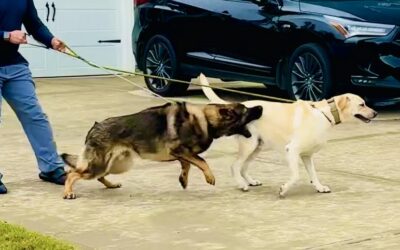
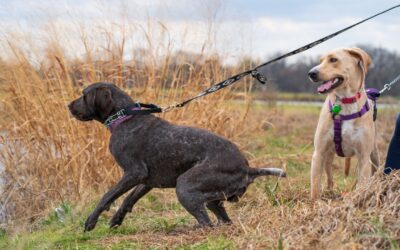
Often linked to leash reactivity, where frustration and arousal on leash boil over into lunging and snapping. The leash itself changes the equation. A dog that’s fine off-leash can fall apart when tethered.
Redirected Aggression
The dog can’t reach what triggered it, so it redirects onto the nearest target. Often startles owners because it seems to come from nowhere.
What Dog Aggression Help Looks Like at Dog Owner’s Academy
We’ve worked with hundreds of aggressive dogs in Charlotte, Matthews, Huntersville, Fort Mill, and throughout the metro since 2008 — including dogs other trainers had already passed on. Our experience covers low-level threat displays, full bite histories, and dogs with serious fight backgrounds.
The first step is always a free in-home consultation. We see your dog in the environment where the behavior actually happens. We assess what’s driving the aggression, walk you through what we’re observing, and build a plan specific to your dog and your household.
From there, the work focuses on three things: reducing the emotional charge around the trigger, building reliable structure that the dog can lean on when pressure rises, and teaching you how to read and respond to your dog before situations escalate. Management strategies get you through the early weeks. The deeper work is what makes management unnecessary over time.
Results vary by dog, history, and severity — we’ll be straight with you about that from the start. What we can tell you is that the dogs we’ve worked with have gone from genuine bite risks to calm family dogs living full lives.
Frequently Asked Questions
My dog has already bitten someone. Can you still help?
Yes. A bite history doesn’t close the door on training. It tells us where the threshold is and how to build below it. Many of the dogs we’ve worked with had bite histories when we started.
Should I be correcting my dog when it growls?
No. The growl is a warning, and warnings are valuable. A dog that’s been punished for growling doesn’t stop feeling threatened — it stops telling you. That’s a more dangerous dog, not a safer one.
Is in-home training safe for an aggressive dog?
We assess the situation before any hands-on work begins. Safety protocols are in place for every aggression case from the first visit. You won’t be asked to do anything we haven’t walked through with you first.
How long does it take to see improvement?
It depends on the dog’s history, the type of aggression, and how consistently the work gets applied. Some families see real shifts in the first lesson. Others take longer. We’ll give you an honest timeline after the assessment — not before.
Take the First Step
If your dog has shown aggression — toward people, other dogs, or anyone in your household — the best next step is a real conversation about what’s actually going on.
Our free in-home consultation is where we start: no pressure, no commitment, just an honest assessment of what your dog is experiencing and what’s possible.
Have Questions About Training?
Not sure which dog training program is right for you and your dog? Call us at 844-864-3647. We’ll learn more about your dog, what’s been difficult, what you’ve already tried, and suggest the next step for your goals.